
Building a powerful gaming computer requires more than choosing a high-performance graphics card and processor. Cooling is equally important because demanding games generate heat that can affect performance, stability, and the lifespan of components. One of the most common questions builders ask is how many case fans they need to maintain good airflow without spending money on unnecessary cooling equipment. 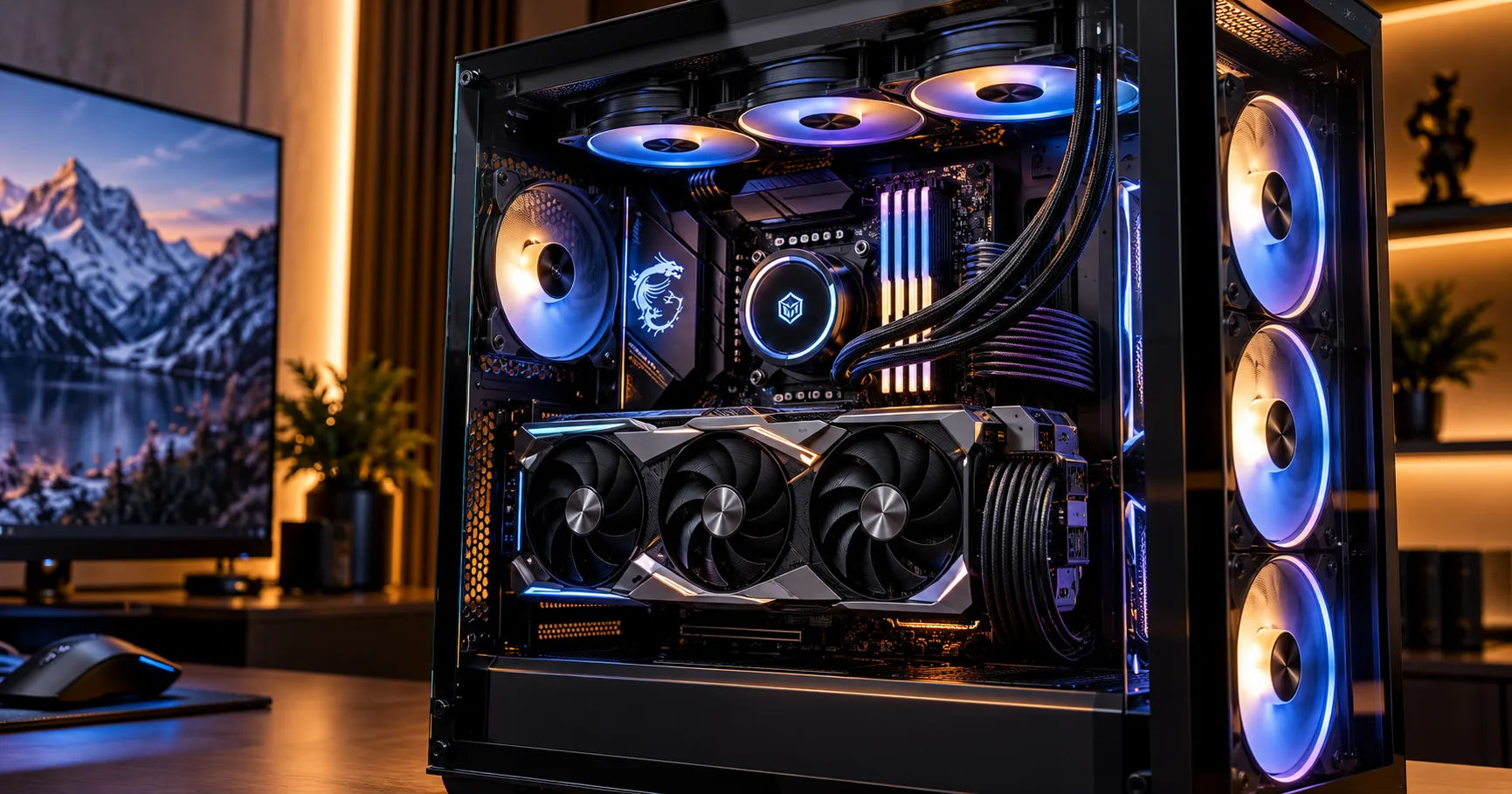 A modern gaming system with a powerful graphics card needs a carefully planned cooling setup. The number of fans depends on the case design, processor, cooling method, and the games you play. A good configuration should move cool air into the case, direct it toward hot components, and remove warm air efficiently.
For most builders, a gaming pc rtx 5080 will work well with approximately four to six case fans, provided the case supports good airflow. This usually means three intake fans at the front and one or two exhaust fans at the rear or top. However, this is a practical starting point rather than a strict requirement. Some compact cases need a different arrangement, while spacious cases with mesh panels may deliver excellent cooling with fewer fans.
Understanding how airflow works will help you choose the right number of fans, avoid unnecessary noise, and keep your gaming system running smoothly during long sessions.
The Cooling Needs of an RTX 5080 Gaming PC
The NVIDIA GeForce gaming pc rtx 5080 is a high-performance graphics card designed for demanding games, high resolutions, and advanced graphical features. Because it can consume substantial power under heavy workloads, it releases considerable heat into the surrounding case.
The graphics card has its own cooling system, usually consisting of multiple fans attached to a heatsink. These GPU fans cool the graphics card itself, but they do not replace the case fans responsible for moving hot air out of the computer.
A powerful processor, motherboard voltage regulators, memory modules, and storage devices also produce heat. If the case cannot remove that heat effectively, temperatures inside the system can rise even when the graphics card's built-in fans are working correctly.
Why Case Fans Matter
Case fans create a continuous flow of air through the computer. Intake fans bring cooler room air inside, while exhaust fans help remove the warm air produced by internal components.
Without sufficient airflow, hot air can accumulate around the graphics card and processor. This may cause fans to spin faster, increasing noise. In extreme conditions, components may reduce their operating speeds to control temperatures.
A well-designed cooling system helps maintain stable performance, improves acoustic comfort, and reduces unnecessary heat buildup.
Does the RTX 5080 Require Special Case Cooling?
The RTX 5080 does not have a universal requirement for a particular number of case fans. Its cooling needs depend on the specific graphics card model, case dimensions, and the rest of the system.
A large graphics card installed in a compact case may restrict airflow and leave little space between the card and nearby panels. A spacious case with a mesh front panel can provide much better ventilation.
Therefore, choose fans based on the entire computer rather than the graphics card alone.
How Many Fans Should You Install?
For a typical mid-tower gaming computer, four to six case fans are a sensible starting point. This arrangement provides enough airflow for many systems without making the build unnecessarily complicated.
The following configurations illustrate how different fan counts can work.
Three Case Fans: A Basic Setup
Three fans can be enough in a well-ventilated case, particularly when the processor uses an efficient cooler and the room temperature remains moderate.
One possible arrangement is:
-
Two front intake fans.
-
One rear exhaust fan.
The front fans supply cool air, while the rear fan removes warm air from the processor and surrounding components.
This arrangement is relatively inexpensive and easy to install. However, a high-power graphics card may benefit from additional airflow, especially in a case with restricted ventilation.
Three fans are best treated as a minimum practical starting point for suitable cases rather than a universal recommendation.
Four Case Fans: A Balanced Setup
Four fans provide a useful balance between cooling, cost, and noise.
A practical arrangement includes:
-
Two front intake fans.
-
One rear exhaust fan.
-
One top exhaust fan.
The front fans direct cool air toward the graphics card and processor area. The rear and top fans help remove warm air as it moves through the case.
This setup can work well for many gaming computers with an RTX 5080. However, fan placement matters. If the top exhaust fan is positioned too far forward, it may remove cool air before that air reaches the processor and graphics card.
For this reason, the rear section of the top panel is often a sensible place to install an additional exhaust fan.
Five Case Fans: An Excellent Starting Point
Five fans are a strong option for builders who want additional cooling without filling every available mounting position.
A typical arrangement is:
-
Three front intake fans.
-
One rear exhaust fan.
-
One top-rear exhaust fan.
Three front fans provide a steady supply of fresh air to the graphics card and other components. The rear and top-rear fans help remove the warm air generated during gaming.
This configuration is particularly useful for a high-performance system running demanding games at 1440p or 4K.
The exact benefit depends on the case. If the front panel is restrictive, adding another fan may provide less improvement than choosing a case with better ventilation.
Six Case Fans: For More Demanding Builds
Six fans are a good choice for gaming systems with powerful processors, extended gaming sessions, or cases that benefit from additional airflow.
One possible configuration is:
-
Three front intake fans.
-
One rear exhaust fan.
-
Two top exhaust fans.
This arrangement can move a substantial amount of air through a compatible case. It is especially useful when both the processor and graphics card generate considerable heat.
Nevertheless, six fans are not automatically better than five. Additional fans may increase noise, turbulence, and power consumption without meaningfully lowering temperatures.
The objective is to establish an effective airflow path rather than maximize the number of installed fans.
Best Fan Placement for an RTX 5080 Gaming PC
Fan placement can matter as much as fan count. Even a case with six fans may cool poorly if the fans work against one another or if airflow is blocked.
Front Intake Fans
Front intake fans are usually the foundation of a good airflow arrangement.
They draw cooler air from the room and direct it toward the graphics card, processor area, and motherboard. Three 120 mm fans are a common choice for cases designed to accommodate them.
Some cases support two larger 140 mm fans instead. Larger fans can often move a useful amount of air at lower rotational speeds, although actual performance depends on their design and the resistance created by filters and panels.
A mesh front panel generally helps air enter the case more easily than a solid, restrictive design.
Rear Exhaust Fan
The rear exhaust fan is an important part of a conventional cooling setup.
Warm air from the processor and graphics card area can move toward the rear of the case, where the fan helps push it outside. A single rear exhaust fan is often sufficient for a balanced build.
Most mid-tower cases support a 120 mm rear fan, while some also accommodate 140 mm models.
Top Exhaust Fans
Warm air naturally tends to rise, so top-mounted exhaust fans can help remove heat from the case.
For many builds, one top-rear exhaust fan is a useful addition. A second top fan may improve cooling when the processor and graphics card produce substantial heat.
However, more top exhaust is not always beneficial. Excessive exhaust airflow can pull cool air out of the case before it reaches important components.
Begin with one top-rear exhaust fan and monitor temperatures before deciding whether another is necessary.
Bottom and Side Intake Fans
Some cases provide bottom or side mounting positions that can improve airflow around a large graphics card.
Bottom intake fans can supply fresh air directly to the GPU, depending on the case layout and clearance beneath it. Side intake fans can also help cool the graphics card when the case is designed for that arrangement.
These positions are optional. They are most useful when testing shows that the graphics card is receiving insufficient cool air from the front intake.
Choosing the Right Fan Size
The number of fans is only one part of the cooling equation. Fan size, blade design, rotational speed, and airflow resistance also affect performance.
120 mm Fans
120 mm fans are widely used because they fit many computer cases and are available in numerous designs.
They can provide strong airflow and static pressure, making them suitable for front intakes, rear exhausts, and radiator installations.
A five-fan configuration using 120 mm models is a practical choice for many gaming systems.
140 mm Fans
140 mm fans have a larger diameter and can move substantial amounts of air at relatively low speeds.
They may offer a quieter cooling solution when the case supports them and their performance is appropriate for the installation.
However, a 140 mm fan is not automatically superior to a 120 mm fan. Check the manufacturer's airflow, noise, and static-pressure specifications rather than relying on size alone.
Airflow Versus Static Pressure
Airflow ratings indicate how much air a fan can move under specified conditions. Static pressure describes its ability to push air against resistance.
Fans installed behind restrictive filters, dense mesh, or radiator fins may benefit from stronger static-pressure performance.
For open exhaust positions, airflow-oriented fans can be appropriate. In practice, a good-quality fan designed for the intended position is more important than choosing a model based on marketing labels alone.
Air Cooling or Liquid Cooling: Does It Change the Fan Count?
The processor cooling method can influence the number and placement of fans in an RTX 5080 system.
Using an Air Cooler
An air cooler typically includes a heatsink and one or two fans. These fans move air through the heatsink, helping transfer heat away from the processor.
They do not normally count as case fans because their main job is to cool the CPU directly.
With an air-cooled processor, a four- or five-case-fan arrangement is a reasonable starting point for a well-ventilated mid-tower case.
Using an AIO Liquid Cooler
An all-in-one liquid cooler uses a radiator and attached fans to dissipate heat from the processor.
A 240 mm radiator generally uses two 120 mm fans, while a 360 mm radiator typically uses three 120 mm fans. Some radiators use 140 mm fans instead, depending on their size and design.
These radiator fans serve a cooling purpose, but their effect on overall case airflow depends on whether the radiator is installed as an intake or exhaust.
For example, a front-mounted radiator configured as an intake can bring cooler room air through the radiator and into the case. A top-mounted radiator configured as an exhaust can remove CPU heat from the case.
Do not assume that a liquid cooler eliminates the need for case fans. The graphics card still requires sufficient fresh air, and the motherboard still benefits from airflow around its components.
How to Maintain Good Airflow
Installing the right number of fans is only the beginning. Their arrangement and maintenance help determine how effectively the system cools.
Create a Clear Airflow Path
Aim for a straightforward route in which cool air enters near the front or bottom and warm air exits near the rear or top.
Avoid installing intake and exhaust fans so close together that they simply exchange air within a small section of the case.
Cable management also matters. Loose cables should not block major airflow paths, particularly around the front intake fans and graphics card.
Maintain Slight Positive Air Pressure
Positive air pressure occurs when the case takes in slightly more air than it exhausts.
A practical way to encourage this is to use three front intake fans and two exhaust fans, assuming the fans have comparable performance and the case is reasonably well sealed.
This arrangement can help reduce the amount of unfiltered air entering through gaps in the case.
However, counting fans alone does not determine air pressure. Fan speeds, filters, radiator resistance, and case openings all influence the result.
Clean Dust Filters Regularly
Dust buildup can restrict airflow and make cooling less effective.
Clean the front intake filters, bottom filters, and other accessible mesh surfaces regularly. The appropriate schedule depends on pets, room conditions, and how frequently the computer is used.
Also inspect the graphics card heatsink and case fans for accumulated dust. Always follow the manufacturer's cleaning guidance and shut down the computer before performing maintenance.
Adjust Fan Curves
Fan curves determine how quickly fans spin as temperatures rise.
A quiet idle profile can keep the system comfortable during everyday tasks, while a more aggressive curve can increase airflow during demanding games.
Use the motherboard's fan-control software or firmware to adjust compatible case fans. Make changes gradually and check temperatures and noise after each adjustment.
How to Check Whether Your Cooling Setup Is Enough
Instead of assuming that a particular fan count is perfect, test the system under realistic workloads.
Monitor GPU Temperatures
Use a reputable monitoring utility to check the graphics card's temperature, fan speed, power consumption, and performance during gaming.
The RTX 5080's exact temperature behavior varies by card model, ambient temperature, case airflow, and workload. Compare readings with the graphics card manufacturer's specifications and operating limits.
Pay attention to sustained temperatures and whether performance remains stable.
Monitor CPU Temperatures
The processor may become the hottest component in some gaming systems, especially when it handles demanding simulations, high frame rates, or background workloads.
Check CPU temperatures during games and during a suitable CPU stress test. Different processors have different thermal limits, so avoid treating one temperature threshold as universal.
If CPU temperatures are unexpectedly high, investigate the cooler installation, thermal interface material, fan direction, and radiator performance before buying more case fans.
Test Before Adding More Fans
Record temperatures during a demanding game with the current setup. Then adjust fan speeds or temporarily test a different fan arrangement.
If temperatures improve substantially when the side panel is opened, the case's airflow may be restrictive. This test is not a permanent solution because an open panel can disrupt the intended airflow path and allow more dust inside.
If temperatures remain normal and noise levels are comfortable, additional fans may offer little practical benefit.
Common Cooling Mistakes to Avoid
Even a powerful computer can have cooling problems when its fans are installed incorrectly.
Installing Every Fan as an Exhaust
If all fans push air out of the case, the system may struggle to bring in enough fresh air through its intake openings.
Use dedicated intake fans and establish a clear airflow path.
Using Too Many Fans at High Speeds
More fans can increase noise and create turbulence. Running every fan at maximum speed is rarely necessary for ordinary gaming.
Start with a balanced setup and increase speeds only when temperatures justify the change.
Ignoring Case Compatibility
Before buying fans, check the case's supported sizes, mounting positions, radiator clearance, and available space around the graphics card.
A large RTX 5080 model may leave limited room for certain fan or radiator arrangements.
Forgetting Room Temperature
A computer operating in a hot room has less access to cool air than one operating in a cooler environment.
If the room temperature increases, component temperatures may rise even when the fans are functioning correctly. Room ventilation and sensible ambient temperature management can therefore help the entire system.
Conclusion
The ideal number of fans for a gaming PC equipped with an RTX 5080 depends on the case, processor, cooling system, room temperature, and workload. For most standard mid-tower builds, four to six case fans provide a practical range to consider.
A four-fan setup with two front intakes, one rear exhaust, and one top-rear exhaust can be sufficient for a well-ventilated case. A five-fan configuration with three front intakes and two exhaust fans offers an excellent starting point for many high-performance gaming systems. Six fans may be useful when additional airflow is needed, but they are not essential for every build.
Remember that the fans built into the graphics card and processor cooler serve different purposes from case fans. Consider all of them when planning your cooling arrangement, but do not count on case-fan quantity alone to guarantee low temperatures.
For the best results, prioritize a mesh-front case, suitable fan sizes, balanced intake and exhaust airflow, clean filters, and properly adjusted fan curves. Monitor GPU and CPU temperatures during demanding games, then make adjustments based on actual results.
Ultimately, a thoughtfully configured gaming pc rtx 5080 does not need the maximum possible number of fans. It needs enough well-positioned fans to supply cool air, remove heat efficiently, and maintain stable performance without excessive noise. Start with four or five quality case fans, test the system under load, and add more only when your temperatures or airflow indicate a genuine need.